In short: A good golf gift is the one that gets used within a week. Golfers replace balls, gloves, and tees constantly, and equipment almost never, so buy the consumable or a better version of something they already carry. If you are tempted by a club, give a gift card toward a fitting instead. Novelty items and engraved barware are shelf risks, not gifts.
We write buying guides, not lab reviews: we have not used every item on this page. Specs come from the manufacturer or the listing, and whatever Amazon shows when you click is the authoritative figure.
The Federal Trade Commission's endorsement guides, 16 CFR Part 255, require a disclosure like that one to be difficult to miss, so it sits above every link here. Our full affiliate disclosure has the rest.
The game is bigger than most gift guides assume. The USGA's 2025 figures put 3.68 million American golfers holding a Handicap Index. This number measures how well someone plays. More than 82 million scores were posted domestically that year. Most of those rounds were casual. That matters for gifting, because a casual golfer's bag runs through consumables fast and holds equipment for a decade.
If you want the short version of this logic applied shelf by shelf, our pillar guide Golf Gifts for People Who Don't Play Golf covers it. Here we go rule by rule.
What Is a Good Golf Gift? The 10-Rule Test
Ask one question before anything goes in the cart: will this be used in the next five rounds? If the answer is no, it is not a good golf gift. It is a decoration with a golf logo.
Here are the ten rules we apply, in the order we apply them:
- Buy what runs out before what lasts forever.
- Upgrade something they already carry every round.
- Never buy a club as a surprise.
- A fitting is the equipment gift that always fits.
- Personalize only what lives on the bag.
- Skip anything that needs a shelf, a wall, or a bar cart.
- Match the gift to their skill level, not to the ads.
- When unsure between two sizes, buy the consumable instead.
- A gift card is a real gift, not a surrender.
- If it needs batteries and a manual, it needs a conversation first.
Across the 13 ranking guides we compared while building this, prices mentioned run roughly $20 to $499, with a median around $70 in our editorial computation. The middle of the market is exactly where consumables live. That is not a coincidence.
Buy the Consumable, Not the Club
Balls disappear. They dive into water, vanish in rough, and get given away to playing partners. Gloves wear through in a month of regular play. Tees break by the dozen. A golfer cannot have too many of any of these, which makes a box of golf balls the closest thing this category has to a guaranteed hit.
The numbers back the casual-first approach. Per the USGA's 2025 release, 94.4% of the 82 million rounds posted were recreational, and more than 75% of golfers with a Handicap Index were playing purely for fun. A fun-first golfer loses balls. They do not need a $400 driver.
We break down ball choice separately in Golf Balls as a Gift: The One Consumable That Works. The short version: unless you know their brand, buy a mid-tier dozen rather than the tour ball they may not play.
Upgrade the Towel, Divot Tool, or Ball Marker
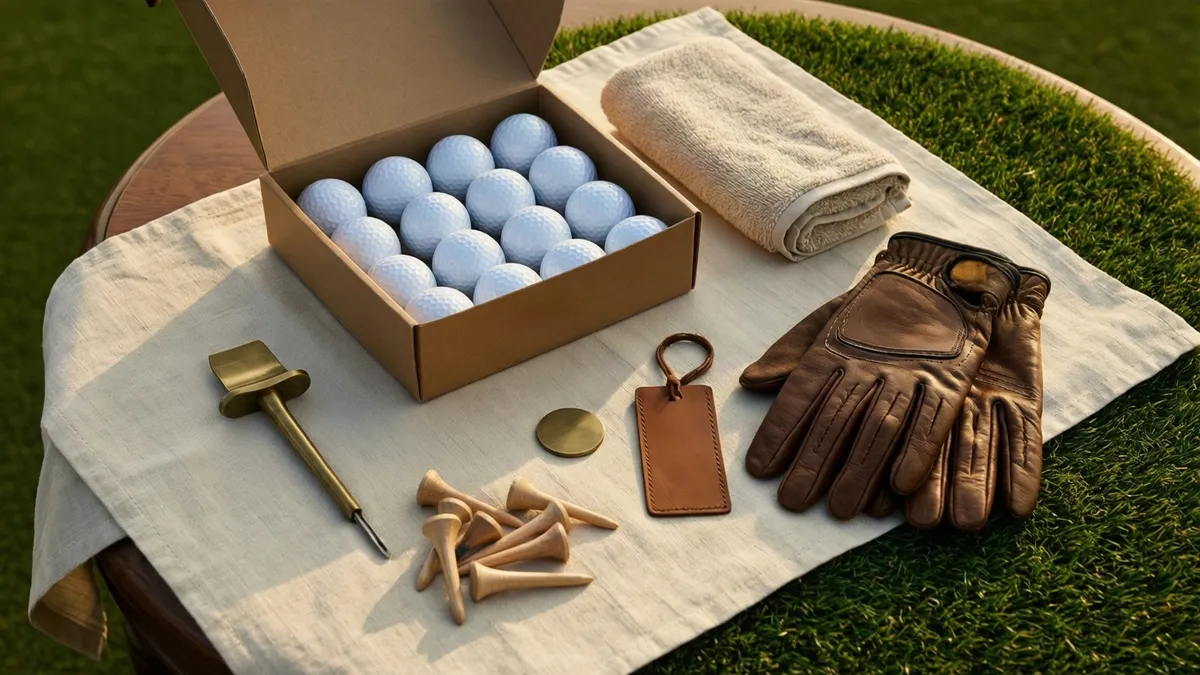
The second move is the better version of something used every round. Every golfer owns a towel, a divot tool, the small fork that repairs ball marks on the green, and a ball marker, the coin that marks a ball's spot. Most own sad versions of all three.
A heavy microfiber towel, a machined divot tool, a magnetic marker upgrades the routine without touching anything fitted. Nothing here needs a size, a flex, or a preference survey. Seven of the 13 guides we compared converge on these small accessories as the safest picks, and our comparison agrees with them for once.
The bag tells you what to buy. These three things clip to it, live on it, and wear out on it. That is the whole test.
If It's Equipment, Buy the Fitting Instead
Clubs are fitted to a player: shaft flex, the stiffness matched to their swing, and loft, the face angle that controls height. Buying one as a surprise is a coin flip. Even a correct-length club in the wrong flex plays like the wrong club.
The fitting is the version that actually gets used. It also tracks a real price trend. Eurostat's 2025 data shows the EU's annual rate for recreational and sporting services rose 4.1%, against an all-items rate of 2.5%. Equipment prices actually fell 0.7% that year. Services keep getting pricier relative to gear, which is exactly why a pre-paid fitting session holds its value as a gift.
A typical custom fitting runs an hour and most shops credit the fee toward a purchase. Ask the shop when you book; policies vary. If the golfer is your partner or parent and you know their specs cold, our golf gifts for men guide handles that case.
When Personalized Actually Works
Personalization is not banned. It is zoned. Anything that lives on the bag is fair game: a monogrammed towel, an engraved ball marker, a leather bag tag. The golfer sees these every round and loses them often enough to welcome a spare.
Off the bag, personalization turns risky. Engraved decanters, tumblers, and barware assume the golfer drinks, displays, and has cabinet space. None of those assumptions survive contact with a small apartment. Six of the 13 guides we compared recommend personalized gifts for golfers who have everything; we would narrow that to bag-worn items only.
The test is the same one from rule one. A bag tag gets used in the next five rounds. A crystal decanter gets dusted.
Laser vs. GPS Watch: What a Beginner Needs
Distance devices are the one tech gift that clears the ten-rule test, because they get used every single round. But the right one depends on how the golfer plays, not on which device reviews better.
| Device | What it does | Why a beginner cares (our judgment) | Price band (ours, not sourced) | Shelf risk (our judgment) |
|---|---|---|---|---|
| Laser rangefinder | Zaps the flag or any target for an exact yardage | Teaches course awareness; works on any course without subscriptions | $100 to $250 | Low once they play regularly |
| GPS watch | Shows distances to green features from a map | Zero aiming skill needed; strap it on and play | $150 to $300 | Moderate if they prefer cart-mounted or phone GPS |
Price bands below are ours, not a sourced figure. A laser rangefinder suits a beginner who walks and wants to learn the course. The watch suits one who wants an answer without aiming at a flag they cannot see. Neither is wrong; the wrong move is buying the expensive one for a golfer who plays four times a year.
Our take: For a true beginner, our call is the GPS watch. It works from the first tee with no skill, no aim, and no learning curve, and it graduates well. The laser is the better gift for the improving intermediate who already knows what a yardage gap feels like. If they play fewer than five rounds a year, skip both and buy balls.
Beginner vs. Scratch Golfer: Two Very Different Gifts
A scratch golfer plays to a zero handicap, meaning consistently excellent. The two ends of the skill spectrum need opposite gifts, and most guides blur this.
Beginners lose balls at a rate that makes any premium ball a waste. Give them forgiving mid-tier balls and, better, a lesson. The infrastructure supports it: the USGA's 2025 data shows more than 290,000 scores posted at more than 470 short courses nationwide. These are entry-friendly venues where a new golfer actually builds the habit. Nine-hole play is booming too, with a record 14,998,824 such scores posted in 2025, a 5% rise over 2024. Short-format golf is where beginners live, and consumables plus lessons fit it.
The scratch golfer inverts the rule. Their balls are chosen, their clubs are fitted, and their gear list is complete. What lands is the personalized upgrade from the section above: the engraved marker, the leather tag, the towel worth retiring the old one for. Our best golf gifts guide sorts recommendations the same way, consumables first and coin flips last.
For a female golfer who prefers neutral colors, the same logic holds with one filter: skip the pink-and-rhinestone aisle. Neutral towels, white gloves, and gray or sand-toned headcovers exist across every major brand's lineup. Our golf gifts for women guide lists them by category rather than by color stereotype.
FAQ: Glove Size, Returns, and the Gift to Avoid
How do I determine the correct glove size without asking them?
Sneak a look at the glove tab tucked in their bag's pocket; sizes are printed right on it. No access? Our golf glove sizing guide walks through measuring a hand at home from a traced outline, and the fallback is always the towel.
How do I return a golf gift if the size or brand is wrong?
Most major retailers accept unused golf gear returns within 30 days, and consumables usually too if sealed. Keep the gift receipt and leave tags on; personalized items are typically final sale, which is one more reason to engrave only cheap bag goods.
What is the difference between a laser rangefinder and a GPS watch for a beginner?
The laser gives one exact number to whatever you aim at; the watch gives several distances to mapped green features automatically. Beginners who struggle to see the flag from 200 yards out are better served by the watch on day one.
Is it better to gift a launch monitor or a simulator screen?
A launch monitor, the device that measures ball flight indoors, starts near a thousand dollars; a screen setup needs a dedicated room, impact-rated material, and often more. For a gift, neither clears rule ten: both need a conversation first, and a lesson package beats both for anyone short of a committed practice routine.
Are there golf gifts safe to give someone who hates golf?
Skip the theme entirely. A generic gift card, a nice insulated bottle, or anything from their actual hobby beats a golf joke mug for the reluctant spouse dragged along to the course. The game's gear only gifts well to people who already play it.
Dan Calloway writes buying guides, not reviews; nothing on this page was tested by us.
Sources
- Eurostat — "Consumer prices of recreational and sporting goods and services" (https://ec.europa.eu/eurostat/statistics-explained/index.php?title=Consumer_prices_of_recreational_and_sporting_goods_and_services) "Retrieved 2026-09-17".
- Federal Trade Commission — "Guides Concerning the Use of Endorsements and Testimonials in Advertising" (https://www.ftc.gov/legal-library/browse/federal-register-notices/guides-concerning-use-endorsements-testimonials-advertising) "Retrieved 2026-09-17".