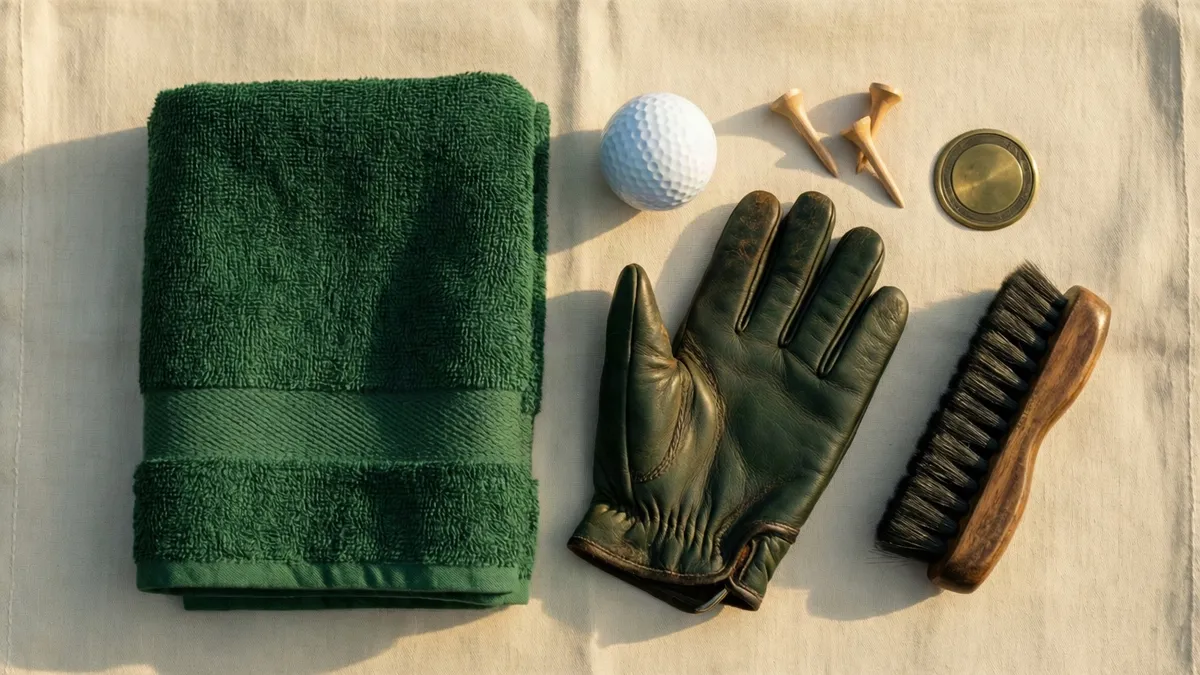
In short: Buy what goes in the bag, not the bag itself. Golfers replace balls, gloves, and towels constantly, and equipment almost never. The blockers are size, fit, and course etiquette — get those right and any consumable gift works.
We write buying guides, not lab reviews: we have not tested every product on this page, and specifications come from the manufacturer or listing. Prices, availability and ratings change constantly — whatever Amazon shows when you click is the authoritative figure.
This article contains affiliate links. If you buy through one, we earn a small commission at no extra cost to you. We only recommend what we would suggest to a friend.
The Federal Trade Commission's endorsement guides, 16 CFR Part 255, require a disclosure like that one to be difficult to miss, so it sits above every link here. Our full affiliate disclosure has the rest.
A bag holds two kinds of things. Consumables wear out, get lost, get soaked, and get replaced several times a season. Equipment was chosen for that specific player, often in a fitting, and replaced almost never. If you have never bought a golf gift before, start with our pillar guide, Golf Gifts for People Who Don't Play Golf. The logic there is the logic here: buy what runs out, skip what sits.
One caution before the categories. The U.S. Consumer Product Safety Commission recalled toy golf clubs in November 1977. The metal rod could separate from the handle, covering models retailed for about $1.50 to $2.50. Cheap novelties were more trouble than useful then, and the same holds now. Avoid novelty golf gifts and focus on gear the golfer will actually carry.
The bag rule: buy what runs out, not what sits
The bag tells you what to buy. Everything in it falls into one of two piles.
The first pile is consumables. Balls, gloves, tees, towels, divot tools, ball markers. These get used, lost, soaked, or worn out. A golfer goes through dozens a season. They are the safe gift because the golfer needs more regardless of skill.
The second pile is equipment. Clubs, shafts, grips, bags. These were chosen for that player, often in a fitting where loft, lie angle, and shaft flex were matched to their swing. Buying one as a surprise is a coin flip. At worst, it sits in a garage for years.
Per the USGA's 2025 Golf Scorecard, more than 82 million scores were posted in the U.S. in 2025, and 94.4% of those rounds were recreational. More than 75% of golfers with a Handicap Index were playing and posting purely for fun. The golfer you are buying for is almost certainly not chasing a tour card. They want a comfortable round, and consumables make that round smoother.
Equipment does not. A driver bought without knowing shaft flex or loft is a guess. The USGA's Equipment Rules require every club to be at least 18 inches long and, except for putters, no longer than 48 inches, but length is the easiest variable. Flex, weight, lie angle, and grip size all matter more, and none can be guessed. For buying for a male golfer, Golf Gifts for Men: What His Bag Already Says applies the same rule from that angle.
This is the bag rule. Buy from the consumable pile and you almost cannot miss. Buy from the equipment pile and you are gambling.
Balls: the one golf gift that gets used every round
Balls are the one gift every golfer uses, every round, without exception.
A golfer loses balls. They end up in water, woods, deep rough, and occasionally a yard two streets over. A dozen premium balls is a gift that gets used up, not stored. That makes it the safest entry point in the entire category.
The R&A's Equipment Rules state a golf ball's weight must not be greater than 1.620 ounces, and the diameter must not be less than 1.680 inches. Every conforming ball meets those specs. Within those limits, manufacturers tune compression, cover material, and dimple pattern for different swing speeds and preferences.
You do not need to know the golfer's handicap to pick a ball. A mid-compression ball from a major manufacturer works for the widest range of players. For a deeper dive, our Golf Balls as a Gift: The One Consumable That Works walks through compression in detail.
Custom or logo balls add a meaningful layer without adding risk. A dozen mid-compression balls with a monogram or a small personal logo costs a bit more and still gets used. The personalization is the gift; the ball is the delivery method.
Avoid novelty balls printed with jokes, faces, or slogans unless you know the golfer's sense of humor well. A ball pulled out in front of playing partners needs to be one they are willing to hit. Also avoid refinished or recycled balls sold as new. The listing will say "refinished" or "lake" if you read carefully. New in box is the standard for a gift.
Gloves: the upgrade that needs one fact
A glove is the one wearable that makes sense as a gift, because it wears out. A golfer who plays regularly replaces a glove every few weeks to a couple of months.
One detail decides the glove. It goes on the hand opposite the one they write with. A right-handed golfer wears the glove on the left hand. A left-handed golfer wears it on the right. This is called the glove hand, and it is the first thing any golf shop asks.
The second detail is size. Gloves run from extra small to extra large, and a glove that is too loose bunches and blisters. If you can find out the glove hand and the size without spoiling the surprise, a premium leather glove is an upgrade most golfers appreciate but rarely buy for themselves.
If you cannot find that out, buy the towel instead. Nobody has ever had too many. Our Golf Glove Sizing for Gift Buyers: Hand and Size breaks down how to measure if you can get a quick look at an old glove. For buying for a woman golfer, Golf Gifts for Women Who Actually Play covers the same logic with recipient-specific notes.
The fallback is simple. A premium glove is a great gift when you know the hand and size. A towel is a great gift when you do not.
Towels, tees, and ball markers: the no-fail shelf
This is the shelf where you cannot miss.
Towels, tees, ball markers, divot tools, and club-cleaning brushes are consumables and accessories that every golfer uses, loses, and replaces. None require a size, a fitting, or a handicap. None violate course etiquette. They land for any relationship, any budget, any skill level.
A microfiber towel with a clip attaches to the bag and gets used every hole. A pack of wooden tees in a couple of lengths gets used every round. A magnetic ball marker sticks to a divot tool or hat clip and gets lost within weeks. A divot repair tool is small, cheap, and always needed.
Personalization works here without adding risk. A monogrammed towel or a custom ball marker with initials adds meaning without adding a sizing variable. The personalization does not interfere with function. A towel with initials still dries clubs.
For the golfer who plays only a few times a year and does not want more gear, this shelf is the answer. A nice towel and a sleeve of balls say "I thought about your game" without adding clutter to a bag that already has everything.
Etiquette-proof gifts: what the course actually allows
Some gifts fail not because of size or fit, but because the course will not allow them.
Portable speakers are the obvious example. They are popular gifts and widely sold, but many courses prohibit them outright, and others restrict them to low volume or cart-only use. A speaker that gets confiscated by the starter or draws complaints from the group behind is not a gift that gets used. If you want to go this route, check whether the golfer's home course allows them before buying.
Denim-style apparel hits the same wall. Most private clubs and many public courses have dress codes that exclude denim, cargo shorts, and athletic-style hoodies. Pants that cannot be worn to the course live in a closet. If you are buying apparel, stick with a golf-specific quarter-zip or polo from a brand the golfer already wears, and confirm the size.
Ball-marking jewelry sounds clever but can cross into equipment rules. The R&A's Equipment Rules define a putter as a club with a loft not exceeding ten degrees, and the USGA's Equipment Rules use the same definition. The concern with jewelry is not the putter itself but whether a ball marker on a chain or ring conforms to the rules around equipment used to mark a ball. Small, flat, conventional ball markers are fine. Anything unusual in size or shape is a question for the golfer's local pro, not a guess you want to make.
The filter is simple. If the course might not allow it, it is not a safe gift. When in doubt, call the pro shop at the golfer's regular course. They will tell you in ten seconds.
When the bag rule fails: golf gift cards and lessons
Sometimes you cannot find out the details. Sometimes the golfer already has everything on the consumable shelf. Sometimes you want to give something bigger than a towel.
This is where gift cards and lessons outperform physical equipment.
A gift card toward a fitting is the generous version of the bag rule. It respects the fact that equipment is personal. The golfer gets the thing they actually need, a club built for their swing, without you guessing at shaft flex or loft. A fitting at a reputable fitter or the golfer's home course pro shop costs more than most consumables, which is why the gift card makes sense as the larger gift.
Lessons work the same way. A single session with a PGA professional is a gift that improves the next round, not just the next hole. Per the USGA's 2025 Golf Scorecard, a record 14,998,824 nine-hole scores were posted in 2025, up 5% over 2024, a sign of how many golfers play casual, shorter rounds. For that golfer, a lesson is more useful than another training aid that collects dust.
The objection is that gift cards feel impersonal. They are not. A gift card to the golfer's own course pro shop says "I know where you play." A lesson with a specific instructor says "I know you want to get better." Both are more personal than a driver in the wrong flex. For more on this, see Best Golf Gifts: Consumables First, Coin Flips Last.
The blocking details: three facts to find out before you buy
Three facts block most golf gifts. Get them and the gift works. Miss them and you are guessing.
The first is glove size and hand. The glove goes on the hand opposite the dominant hand. Size runs from XS to XXL. Check an old glove in the bag. The size is printed inside.
The second is ball preference. Most golfers have a brand or model they prefer. A quick look at the bag reveals what they play. Match it, or buy the same brand's mid-compression option.
The third is shaft flex. This applies only if you are buying a club, which we recommend against as a surprise. The flex is printed on the shaft, letters like R for regular, S for stiff, or X for extra stiff. But knowing the flex does not give you the lie angle, loft, or weight. A gift card toward a fitting is still the better call.
Here is a checklist you can copy and fill in before you shop:
Before you buy, six things to find out:
- Glove hand (opposite dominant hand): ___
- Glove size (check inside an old glove): ___
- Ball brand and model (look in the bag): ___
- Home course name (for a gift card or etiquette check): ___
- Shirt size (only if buying golf-specific apparel): ___
- Any equipment or dress-code rules at their course (ask the pro shop): ___
Get those six lines filled in and every gift in this guide becomes easy.
| Category | Buy this | Skip that | Why (our judgment) |
|---|---|---|---|
| Balls | Mid-compression dozen, new in box | Refinished or novelty balls | Consumable, no size needed |
| Gloves | Premium leather, correct hand and size | Wrong hand or one-size-fits-all | Needs one fact; wrong hand is useless |
| Towels | Microfiber with clip, monogrammed | Decorative towel without a clip | Used every round, no sizing |
| Tees | Wooden tees, mixed lengths | Plastic novelty tees | Consumable, lost constantly |
| Ball markers | Flat, conventional, personalized | Oversized or 3D markers | May not conform to rules |
| Clubs | Gift card toward a fitting | A driver bought blind | Requires fitting; violates the bag rule |
| Speakers | Check course rules first | Portable speaker as a surprise | Etiquette blocker; many courses ban them |
| Apparel | Golf-specific quarter-zip, correct size | Denim or cargo style | Dress codes exclude non-golf apparel |
Our take: The bag rule settles most of this. If the golfer is a regular player, a dozen mid-compression balls and a premium glove in the right size will get used before the season ends. If you cannot confirm the glove size, swap it for a monogrammed towel and you have lost nothing. Our call for the golfer who has everything is a gift card toward a fitting at their home course, not another piece of equipment bought blind. The one recipient where we would deviate is the golfer who plays two or three times a year. For them, a nice towel and a sleeve of balls is the better call than a fitting they may never use.
Which is better to gift: a rangefinder, a GPS watch, or a launch monitor?
None of these are consumables, so the bag rule puts them outside the safe zone. A rangefinder is the most universally useful if the golfer does not already own one, but many competitions restrict features like slope adjustment. A GPS watch is more convenient but redundant if the golfer already uses a phone app for distances. A launch monitor only makes sense for a golfer who practices frequently and wants data, so confirm that preference before spending.
What is the right golf gift for a specific handicap level?
Handicap matters less than you think. Per the USGA's 2025 Golf Scorecard, 3.68 million golfers maintained a Handicap Index in 2025. This is up more than 8.2% year over year, but that is still a fraction of all golfers. Most players do not track one formally. A mid-compression ball and a premium glove work across handicap ranges because they are consumables, not performance-tuned equipment. If the golfer has a single-digit handicap and strong preferences, match their ball brand exactly rather than guessing at a model.
Which gifts are actually allowed by course etiquette?
Conventional consumables like balls, tees, towels, divot tools, and flat ball markers are always allowed. Portable speakers, denim-style apparel, and oversized ball-marking jewelry are the common violations. The safest check is a phone call to the pro shop at the golfer's regular course; they will confirm in under a minute. Private clubs tend to be stricter than public courses on both dress code and electronics.
What should I buy a golfer who plays only a few times a year?
A premium towel and a sleeve of mid-compression balls. This golfer does not need a fitting, a rangefinder, or a training aid. They need a couple of nice things that make their occasional rounds more comfortable and that do not take up shelf space between rounds. A personalized ball marker is a small, low-cost addition that works here too.
Is a lesson or gift certificate perceived as too impersonal?
For the right golfer, it outperforms physical gifts. A lesson with a specific instructor says "I know you want to improve," which is more personal than a club in the wrong flex. A gift card to the golfer's home course pro shop says "I know where you play." The key is specificity: a generic big-box gift card feels impersonal, but one tied to their course or a named instructor does not.
Which golf gifts get re-gifted, returned, or left unused most often?
Equipment bought without a fitting, drivers, iron sets, putters, tops the list. Training aids are second, because most golfers try them once and shelve them. Novelty gifts like mugs, signs, and desk accessories are third, because they never touch the course. Consumables are almost never re-gifted, because they get used up.
Dan Calloway writes buying guides, not reviews; nothing here was tested by us.
Sources
- U.S. Consumer Product Safety Commission — "Toy Golf Clubs Recalled" (https://www.cpsc.gov/Recalls/1977/toy-golf-clubs) "Retrieved 2026-08-24".
- The R&A — "Conformance of Balls" (https://www.randa.org/id-ID/roe/the-rules-of-equipment/part-4-conformance-of-balls) "Retrieved 2026-08-24".
- The R&A — "Conformance of Clubs" (https://www.randa.org/sr-Latn/roe/the-rules-of-equipment/part-2-conformance-of-clubs) "Retrieved 2026-08-24".
- Federal Trade Commission — "Guides Concerning the Use of Endorsements and Testimonials in Advertising" (https://www.ftc.gov/legal-library/browse/federal-register-notices/guides-concerning-use-endorsements-testimonials-advertising) "Retrieved 2026-08-24".