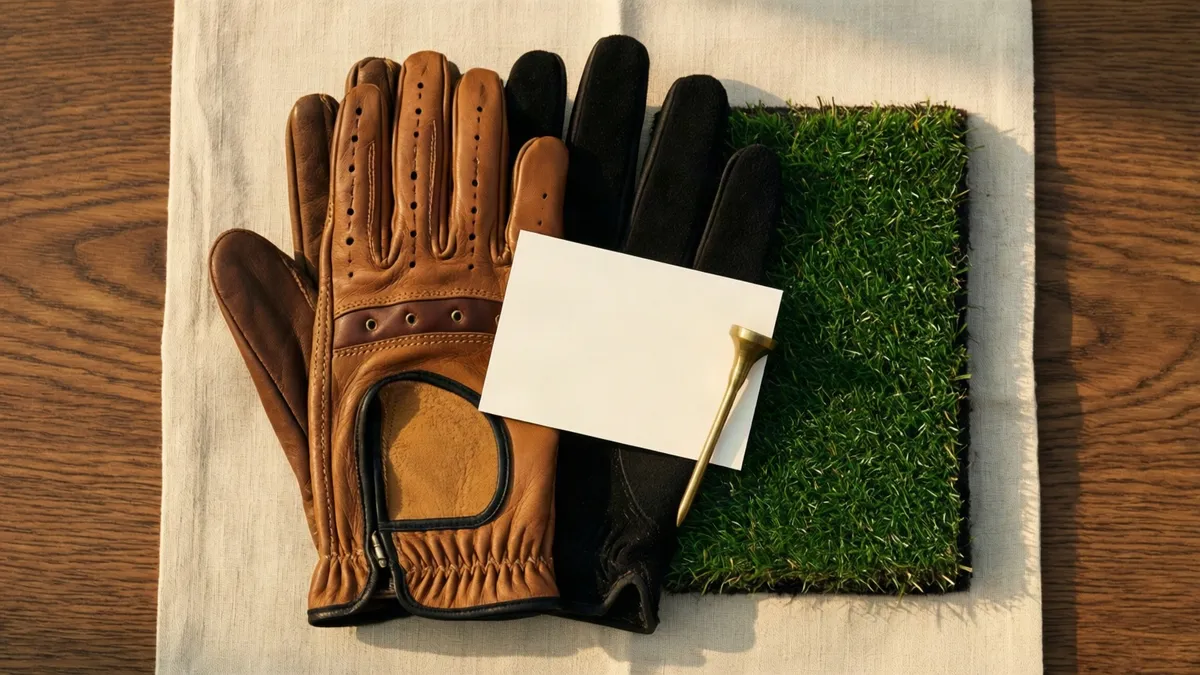
In short: The best golf glove for a gift is the one that fits the golfer's hand and gets used every round. That means a three-pack of the glove they already play, or a single size-confirmed upgrade in Cabretta leather. A glove in a guessed size is the most common gift mistake; it sits in the bag or gets returned. Buy the consumable, not the keepsake.
We write buying guides, not lab reviews: we have not tested every glove on this page. Specs come from the manufacturer or the listing, and whatever Amazon shows when you click is the authoritative figure.
This article contains affiliate links. If you buy through one, we earn a small commission at no extra cost to you. We only recommend what we would suggest to a friend.
The Federal Trade Commission's endorsement guides, 16 CFR Part 255, require a disclosure like that one to be difficult to miss, so it sits above every link here. Our full affiliate disclosure has the rest.
A glove is the cheapest piece of equipment a golfer touches every round, and the piece most likely to be worn out. That makes it a near-perfect gift, with one trap: sizing. Our Golf Gifts for People Who Don't Play Golf guide calls gloves one of the few safe categories. This page is the deep dive.
The timing fits too. The National Retail Federation's 2026 figures put average Father's Day spending at $226.58, up from $199.38 in 2025.
Forty-five percent of shoppers are buying for a father or stepfather, and 25% are buying for a husband. A three-pack of good gloves takes a small slice of that budget and gets used completely.
The one rule for golf glove gifts
Gloves run out. Leather stiffens, palms wear through, seams let go, and golfers replace them several times a season. Equipment is chosen for one specific player; a consumable is chosen for one budget. That is the whole difference.
The gift-giving data pushes the other way, and resist it. The federation's 2026 survey found 44% of shoppers want something unique or different, and 34% want a gift that creates a special memory. A glove is not unique. It disappears into the bag and gets used every Saturday, which is better than being remembered.
Meanwhile, Father's Day spending is expected to hit a record $27.9 billion in 2026, per the same NRF release. Plenty of that lands in drawers. So the rule: if it gets used up, it is the right kind of gift. If it needs to fit, it needs a size.
What the glove hand tells you
One spec matters here, and it is not brand or color. Golfers wear a single glove on the lead hand, the hand at the top of the grip. For a right-handed golfer, that is the left hand. A left-handed golfer playing right-handed clubs wears it on the right. Buy the wrong hand and the gift is decorative.
Watch any broadcast and you will see gloves come off on the greens, where feel matters more than grip. That is normal, not a quirk. The glove exists for full swings, which is why it wears out in the palm first.
There is a second wrinkle called cadet sizing: a wider palm cut for shorter fingers. Plenty of golfers need it and do not know the word for it. Before you buy anything, fill in our checklist, which we suggest photographing into your notes:
- Glove hand: left or right.
- Size off the current glove's cuff label, if you can get it.
- Cadet: yes, no, or unknown.
- Material of the glove they play now.
- Home course climate: hot, humid, or rainy.
Cabretta leather versus synthetic for gifts
Cabretta is thin, soft leather from hair sheep, and it is the feel standard in this category. In our comparison of 12 ranking guides, 9 of the 12 name Cabretta leather the premium choice for grip and feel. That consensus matches the price ladder: across those same pages, prices mentioned run roughly $10 to $75 with a median near $25, our computation, not a sourced figure.
Synthetic gloves trade feel for forgiveness. They cost less, stretch more, last longer, and grip better when wet. A single premium Cabretta glove is the upgrade gift; a synthetic two-pack is the safe one.
As a gift decision, the split is simple. Leather says "I know you play." Synthetic says "I know you play, and I did not gamble on your size." Both beat a keepsake.
Why fit beats brand in golf gloves
Fit is the second-skin test: no excess material at the fingertips, no bunching in the palm, snug across the knuckles. A loose glove folds and slips; a tight one splits at the seam. Brand counts for less than the size printed inside the cuff.
Sizing is genuinely nonstandard, which is the part most gift buyers never learn. A 2019 Hometrica Consulting study compared 3D hand scans of 30 subjects against the published spec of a single women's leather glove model. One size grid, thirty different hands. The gaps are built into the category.
So judge fit remotely, in this order:
- Find the glove they currently play and read the size inside the cuff.
- Check whether that label says cadet; if it does, never substitute regular.
- If the label is out of reach, ask the person who shops with them.
- When size stays unknown, buy synthetic in the larger direction, since it stretches.
- If even that fails, give a gift card toward gloves or a golf glove sizing session instead.
Our sizing guide for gift buyers walks through measuring a hand when no current glove is available.
The three-pack move: buy the glove they already use
The safest version of this gift is not a different glove. It is more of the same one. Golfers are loyal to a model that fits. A three-pack of Cabretta leather gloves in the confirmed size is a full season of the thing they would have bought anyway.
Getting the confirmation is easier than it sounds. Peek in the bag trunk, ask a spouse, or text a golfing friend one question. The surprise survives; the size does not have to be a mystery.
Channel matters here too. The NRF's 2026 survey found online is the most popular Father's Day shopping destination at 38%, ahead of department stores at 37%. Buying online means no trying on, which is exactly why the label check happens before the click, not after. For more on reading a golfer's bag first, see Golf Gifts for Men: What His Bag Already Says.
Gloves share the trait that makes Golf Balls as a Gift work: they run out on a schedule the recipient already pays for.
Breathability and wet weather decide the material
Hot weather changes the answer. Sweaty hands need a glove that breathes: perforated leather or synthetic mesh panels that wick moisture. A heavy leather glove in humid heat turns into a soaked rag by the tenth hole, and the golfer knows it.
Rain inverts the rules. Synthetic rain gloves are built to grip better when damp, and they are worn on both hands at once, then swapped off between shots. A pair of rain gloves is a sharp niche gift for anyone who plays through drizzle instead of rescheduling.
Match the material to their conditions, not to the brochure. Hot and dry favors leather. Humid or wet favors synthetic. Unknown favors the three-pack of whatever they already chose for themselves.
The best golf gloves for gifts, compared
Six glove types cover nearly every gift situation. Price bands below are ours, not a sourced figure, and the Gift Verdict column is our editorial judgment.
| Glove type | Price band (ours) | Material | Fit notes | Gift verdict (ours) |
|---|---|---|---|---|
| Premium Cabretta leather | $20–$40 | Cabretta leather | Second-skin fit; sizing varies by maker | Safe single gift only with a confirmed size |
| Budget synthetic | Under $10 | Synthetic | Stretchy; forgives half a size | Safest cheap single; better as a two-pack |
| Leather-synthetic hybrid | $12–$20 | Blend | Middle ground on feel and stretch | Good default when you know size but not brand |
| Rain glove pair | $15–$25 | Knit synthetic | Worn on both hands; grips better wet | Sharp niche gift for the all-weather golfer |
| Cadet-fit leather | $20–$35 | Cabretta leather | Wider palm, shorter fingers | Only after cadet is confirmed off the current label |
| Padded arthritic-grip glove | $25–$40 | Padded synthetic | Roomier cut; padded designs vary widely | Revelatory for the right recipient; skip otherwise |
Our take: Our call is the three-pack, every time, unless you can read the size off a glove they already own. Leather is the better gift where summers run hot and dry; synthetic wins in humidity and rain. Padded gloves are the one specialty pick worth researching, but only when arthritis or grip pain is a known fact rather than a guess.
One check before the padded route: the USGA's 2019 equipment rules define padding as glove material more than 0.025 inches (0.635 mm) thicker than adjacent areas. The R&A draws the line the same way. Beyond that, the glove is non-conforming for competition. Weekend golfers will not care; tournament golfers will.
FAQ: golf glove gifts, sizing and care
How many rounds does a leather golf glove last?
There is no fixed number; grip pressure and climate decide. A glove played several times a week in heat is often finished within a couple of months, while a weekend glove can last a season. Rotating two or three gloves, letting each dry flat between rounds, stretches every one of them.
How do I measure a hand for cadet versus regular sizing?
Measure across the widest part of the palm below the knuckles, then measure middle-finger length from the crease. A wide palm with shorter fingers points to cadet; a narrow palm with long fingers points to regular. The sizing guide linked above has the full walkthrough.
Do left-handed golfers wear a different glove?
A left-handed golfer playing right-handed clubs wears the glove on the right hand. Gloves are sold by the hand they go on, so confirm the listing says right hand. The construction is simply a mirror image, nothing more.
What is the right way to clean a leather golf glove?
Hand-wash it in lukewarm water with mild soap, rinse, and pat dry with a towel. Then dry it flat, away from radiators and direct sun, since heat is what stiffens leather. Skip heavy conditioner; it softens the palm past the point of grip.
Do golf gloves actually prevent blisters?
Mostly yes, by stopping the grip from twisting against bare skin. But recurring blisters usually point to a grip-pressure habit or a wrong glove size, and a new glove alone will not fix either problem.
Are there eco-friendly golf glove options?
A few makers now advertise vegetable-tanned leathers or recycled synthetics; the listing states the material, so read it before buying. Durability is the greener lever anyway: a rotated three-pack outlasts a drawer of single gloves per glove used.
Written by the editorial team behind this site — gift researchers who compile buying guides from public sources, manufacturer specs, and customer reviews rather than hands-on product testing.
Dan Calloway writes buying guides, not reviews; nothing here was tested by us.
Sources
- United States Golf Association (USGA) — "Equipment Rules 2019 - 2. Gloves (Rule 4.3)" (https://www.usga.org/equipment-standards/equipment-rules-2019/equipment-rules/part-6-rule-3.html) "Retrieved 2026-09-25".
- The R&A — "Devices and Other Equipment" (https://www.randa.org/ja-JP/roe/the-rules-of-equipment/part-6-devices-and-other-equipment) "Retrieved 2026-09-25".
- Hometrica Consulting — "Comparison of Glove Specifications, 3D Hand Scans, and Sizing of Sports Gloves for Athletes - 19.109" (https://doi.org/10.15221/19.109) "Retrieved 2026-09-25".
- National Retail Federation — "Father's Day Spending to Hit Record $27.9 Billion" (https://nrf.com/media-center/press-releases/father-s-day-spending-to-hit-record-27-9-billion) "Retrieved 2026-09-25".
- Federal Trade Commission — "Guides Concerning the Use of Endorsements and Testimonials in Advertising" (https://www.ftc.gov/legal-library/browse/federal-register-notices/guides-concerning-use-endorsements-testimonials-advertising) "Retrieved 2026-09-25".